De Gruyter Presents
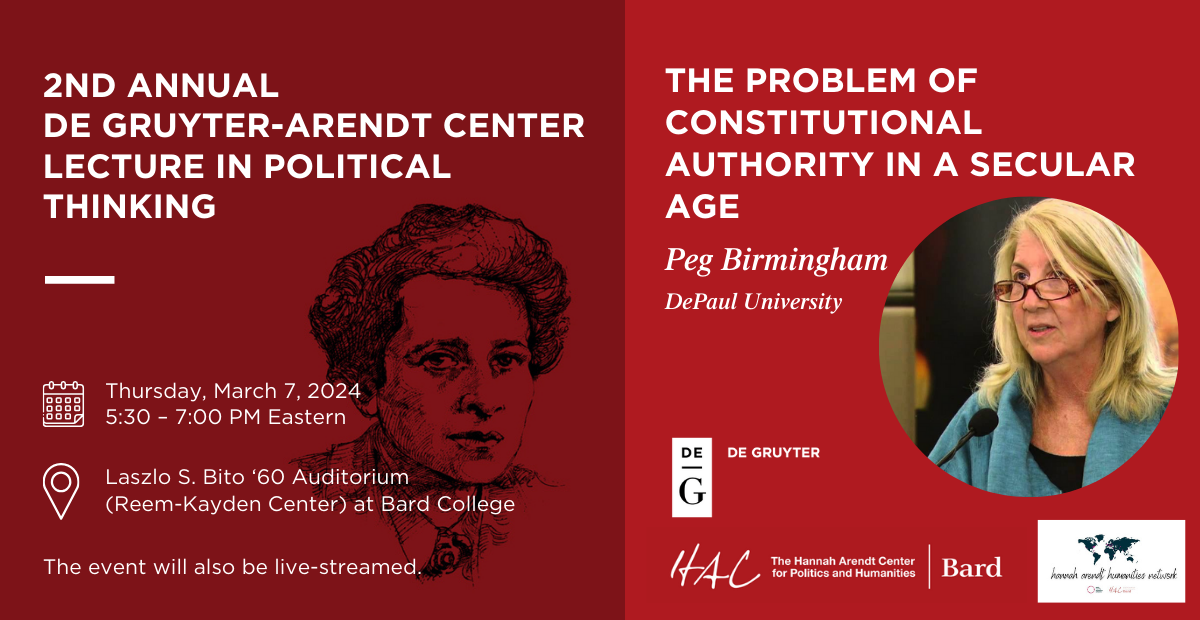
Peg Birmingham: The Problem of Constitutional Authority in a Secular Age
Thursday, March 7, 2024
Reem-Kayden Center Laszlo Z. Bito '60 Auditorium
5:30 pm – 7:00 pm EST/GMT-5
Join us for the 2nd Annual De Gruyter-Arendt Center Lecture in Political Thinking5:30 pm – 7:00 pm EST/GMT-5
This lecture will be live streamed on our Youtube Channel
Peg Birmingham (DePaul University)
“The Problem of Constitutional Authority in a Secular Age”
at the Laszlo S. Bito ‘60 Auditorium (Reem-Kayden Center) at Bard College
Event will be live-streamed
The Problem of Constitutional Authority in a Secular Age
Peg Birmingham
[1] “More important in our context [of thinking the meaning of revolution] is that
Machiavelli was the first to visualize the rise of a pure secular realm whose laws and
principles of action were independent of the teachings of the Church in particular and of
moral standards, transcending the sphere of human affairs, in general. It was for this
reason that he insisted that people who entered politics should first learn “how not to be
good,” that is, how not to act according to Christian precepts” (On Revolution, 36).
[2] “[it was] secularization itself, and not the contents of Christian teachings, which
constitutes the origin of revolution” (On Revolution, 26).
[3] “Politically, secularism means no more than religious creeds and institutions have no
publicly binding authority and that conversely, political life has no religious sanction.”
(“Religion and Politics” in Essays in Understanding, 372).
[4] “One cannot fail to register her insistence that even such politics [self-contained and
post-metaphysical] must have continuing recourse to an absolute of the kind that
metaphysics in the form of religion provided more plausibly and effortlessly than
revolution could easily succeed in doing” (Samuel Moyn, “Arendt on the Secular,” p. 76).
[5] “European absolutism in theory and practice, the existence of an absolute sovereign
whose will is the source of both power and law, was a relatively new phenomenon; it had
been the first and most conspicuous consequence of what we call secularization, namely,
the emancipation of secular power from the authority of the Church” (On Revolution,
159).
[6] “...secularization, which never denied religious content (this is an impossibility!) but
rather posed the ancient problem of earthly immortality anew” (Denktagebuch, Heft XX,
entry 2, 478).
[7] “In the political realm we deal always with adults who are past the age of education,
properly speaking, and politics or the right to participate in the management of public
affairs begins precisely where education has come to an end” (“What Authority?” in
Between Past and Future, 119).
[8] “[Authority] insofar as it is based on tradition, is of Roman political origin and was
monopolized by the Church only when it became the political as well as spiritual heir of
the Roman Empire” (“Religion and Politics” in Essays in Understanding, 372).
[9] [The loss of authority] allows for confronting “anew, without the religious trust in a
sacred beginning and without the protection of traditional and therefore self-evident
standards of behavior, by the elementary problems of human living-together” (“What is
Authority?”, 141).
[10] “Freedom and equality are political principles determined not by a transcendental
authority, before which all humans qua humans are equal, nor by a general human fate
like death, which one day takes all men equally from the world. Rather, they are
intrinsically worldly principles, which grow up directly from the coming together...” (“The
Hungarian Revolution and Totalitarian Imperialism” in Thinking Without a Bannister,
135).
[11] “[T]hey found it easy to think of passion in terms of desire and to banish from it any
connotation of its original meaning, which is prattein: to suffer and to endure. This lack
of experience gives their theories, even if they are sound, an air of lightminded, a certain
weightlessness which will put into jeopardy their durability. For humanly speaking, it is
endurance which enable man to create durability and continuity” (On Revolution, 95).
[12] “The modern growth of worldlessness, the withering away of everything between us,
can also be described as the spread of the desert” (“Epilogue” in The Promise of Politics,
201).
[13] “transform the desert into a world...through the conjoined faculties of passion and
action” (“Epilogue,” 202).
[14] [The condition for action are these passions] as “only those who can endure the
passion of living under desert conditions can be trusted to summon up in themselves the
courage that lies at the root of action, of becoming an active being” (“Epilogue,” 202).
[15] “[World-disclosing passions are measured] not in the force with which the passion
affects the soul, but rather by the amount of reality the passion transmits to it” (Men in
Dark Times, 6).
The Keynote Lecture of our two day Spring Conference:
Between Power and Authority: Arendt on the Constitution and the Courts
The U.S. Supreme Court today faces a crisis of legitimacy. More than half of Americans have an unfavorable view of the Court—the lowest in over three decades. Following a slate of rulings on abortion, affirmative action, student debt, and freedom of religion, an increasing number of Americans no longer believe the Court is impartial, viewing it as simply another partisan institution. As a result, many are calling for various reforms of the Court, including term limits and packing the court. At the same time, the Court has, even at this moment, has struck down racially motivated gerrymandering in Alabama and has refused to accept the Independent State Legislature Theory that would allow states to overturn the will of their voters. There is little doubt that politics is at play in the Supreme Court; at the same time, the Court still gives credence to the idea of the rule of law and not men.
In On Revolution, Hannah Arendt places the American constitutional tradition at the center of her inquiry into the founding and preserving of political freedom. The success of the American Revolution, for her, consisted in two things: its unleashing of citizen power through the principle of federalist dispersion of power and its institutionalization of authority in the Supreme Court and the United States Constitution. Regarding the former, Arendt argues that the embrace of federalism allowed for the multiplication and flourishing of power within a stable system. Regarding the latter, Arendt offers an original reading of the Supreme Court as the successor of the Roman Senate. The Court's authority combined with the surprising fact that the Constitution came to be worshiped allowed the United States to achieve authority for its laws absent religious sanction. This authority tied together permanence and change, permitting the country to develop and grow while also maintaining order and stability. In short, the combination of power and authority that emerged from the worship of the United States Constitution became the modern condition for the possibility of founding free government.
This conference aims to bring together scholars of Arendt’s constitutional thought and those working in political and legal theory more broadly to pursue the following questions: Is the Supreme Court still a legal institution, one that wields and deserves the authority imbued by the rule of law? Is the Supreme Court simply an undemocratic institution of power? If the latter, should we abandon the charade that the Supreme Court is above politics? Or, should we work to uphold the reality and the illusion that the Court is a legal and not simply a political institution? Any answers to these questions request that we face what is lost if and when the Supreme Court is no longer recognized as a seat of authority. We are especially interested in papers that address: Arendt’s conception of power and/or authority, Arendt’s constitutional and/or legal theory, and the relevance of all of this for current discussions of the Supreme Court and constitutional politics.
Registration and Format
The event will take place in-person and will be free and open to the public. Please direct any questions to Nicholas Dunn ([email protected]).
For more information, call 845-758-6822.
Time: 5:30 pm – 7:00 pm EST/GMT-5
Location: Reem-Kayden Center Laszlo Z. Bito '60 Auditorium
 Save this Event: