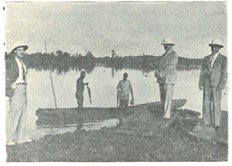
[Lebanese Syrian publisher and traveler Kamel Murrouwa in French Guinea with local fishermen on the Congo River. From: Kamel Murouwwa, Nahnu fi Ifriqiya: al-Hijra al-Lubnaniyya al-Suriyya ila Ifriqiya al-Gharbiyya, Madiha, Hadiriha, Mustaqbaliha. (We are in Africa: The Lebanese Syrian migration to West Africa, its Past, Present, and Future) Beirut: Al-Makshuf, 1938.]
Dean of the College, Historical Studies Program, and Middle Eastern Studies Program Present
Beyond Borders: Gendered Histories of Colonial and Postcolonial Race-Making in the Middle East and North Africa
Dahlia El Zein, PhD Candidate, Department of History, University of Pennsylvania
Tuesday, December 12, 2023
Hegeman 204A
5:30 pm EST/GMT-5
As a system of social differentiation in the Middle East and North Africa during colonialism and postcolonialism, race defied fixed categorizations, while also moving across time and space. This fluidity was exemplified by the increasing presence of Lebanese Syrians in colonial French West Africa (1895-1958) during French mandate rule (1920-1946) in the Levant. Although the economic prowess of this Levantine community in West Africa has been studied—emphasizing their role as an entrepreneurial trader class leveraging the colonial economy for upward mobility—the Lebanese Syrian diaspora in West Africa has been notably absent from histories of race-making under French colonialism, despite the enduring legacies of such processes in the Levant, broader Middle East, and North Africa.5:30 pm EST/GMT-5
In this talk, I discuss the main findings of my research, which traces the movement of Lebanese Syrians across the French empire in the early-to-mid 20th century. I show how racialization transformed as people moved from Beirut to Marseille to Dakar and back, influencing the shifting racial positionalities of this mobile group as well as those in the places through which they moved. Using diverse sources that include official documents, travelogues, memoirs, periodicals, family papers, cemeteries, and novels in Arabic, French, and English from Beirut, Dakar, and Paris, I argue that mobile processes of racialization were also gendered. Women faced the lion’s share of biopolitical regulation from French colonial authorities and Levantine and West African communities, while men became the visible face of this control as key bodies for the making of racialized subjects across the Empire and in the polities that would replace it.
For more information, call 845-758-7667, or e-mail [email protected].
Time: 5:30 pm EST/GMT-5
Location: Hegeman 204A
 Save this Event: