Dean of the College and Sociology Program Present
What do people complain about when they complain about banks?
Text Analysis of Consumer Complaints Submitted to the CFPB
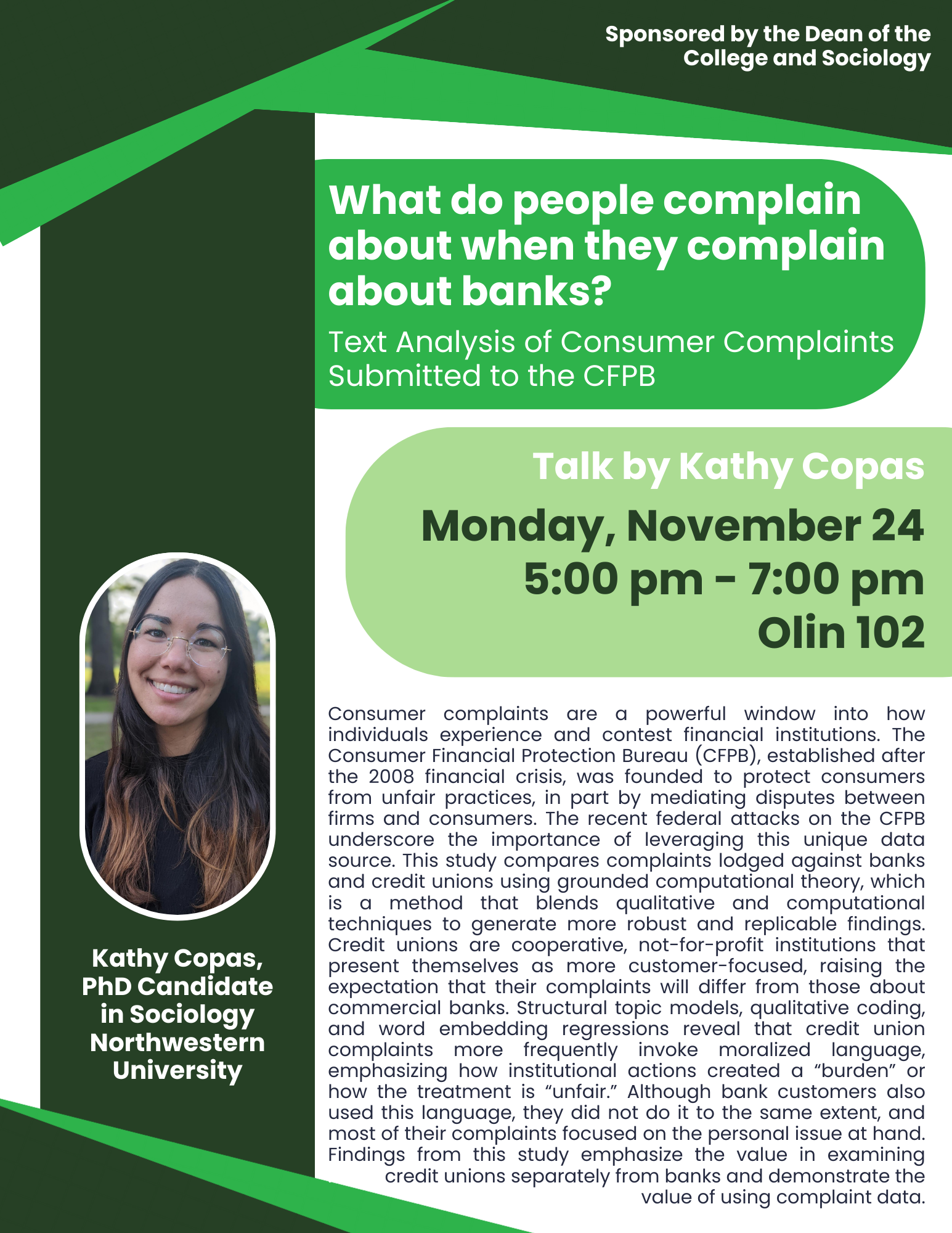
Kathy Copas, PhD Candidate in Sociology, Northwestern University
Olin Humanities, Room 102
5:00 pm EST/GMT-5
Consumer complaints are a powerful window into how individuals experience and contest financial institutions. The Consumer Financial Protection Bureau (CFPB), established after the 2008 financial crisis, was founded to protect consumers from unfair practices, in part by mediating disputes between firms and consumers. The recent federal attacks on the CFPB underscore the importance of leveraging this unique data source. This study compares complaints lodged against banks and credit unions using grounded computational theory, which is a method that blends qualitative and computational techniques to generate more robust and replicable findings. Credit unions are cooperative, not-for-profit institutions that present themselves as more customer-focused, raising the expectation that their complaints will differ from those about commercial banks. Structural topic models, qualitative coding, and word embedding regressions reveal that credit union complaints more frequently invoke moralized language, emphasizing how institutional actions created a “burden” or how the treatment is “unfair.” Although bank customers also used this language, they did not do it to the same extent, and most of their complaints focused on the personal issue at hand. Findings from this study emphasize the value in examining credit unions separately from banks and demonstrate the value of using complaint data.5:00 pm EST/GMT-5
Kathy is an economic sociologist interested in financial services access and affordability. Her current work focuses on credit unions and how they shape the broader financial environment and people's experiences with them compared to traditional commercial banks. Her past scholarship has examined labor union support and organizational reputation management among large banks. She is versed in qualitative content analysis, computational text analysis, and advanced quantitative methods. When teaching methods, she emphasizes the importance of centering the research question and matching data and methods to answer the question.
For more information, call 845-758-6822.
Time: 5:00 pm EST/GMT-5
Location: Olin Humanities, Room 102
 Save this Event: