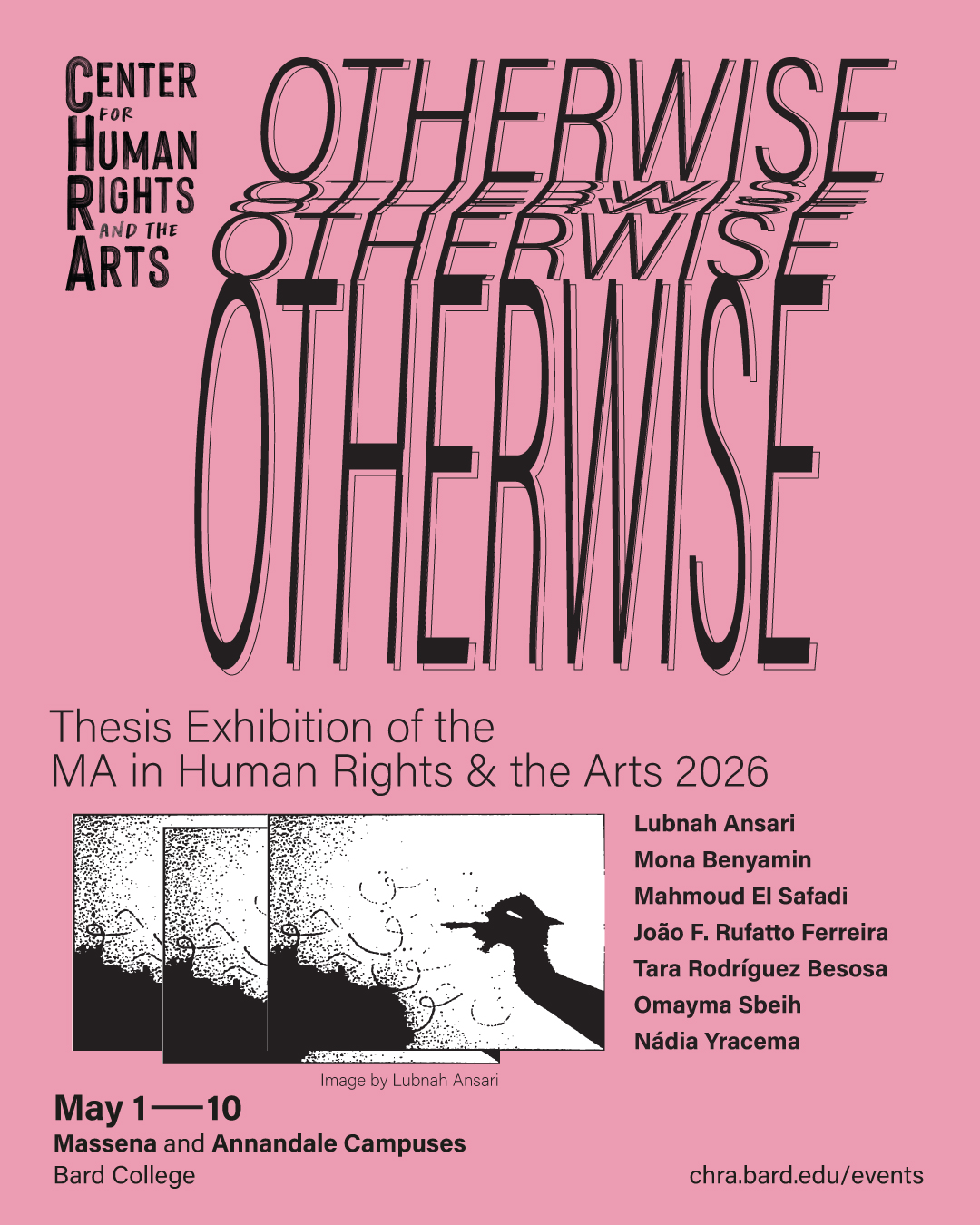
OTHERWISE: Thesis Exhibition of the MA in Human Rights & the Arts 2026
Runs through Sunday, May 10, 2026
Massena Campus
The MA Program at the Center for Human Rights & the Arts is pleased to announce the thesis exhibition of the MA in Human Rights & the Arts, Class of 2026.
The exhibition is taking place May 1 through May 10, at the Massena and Annandale campuses at Bard College. It features installations, films, and written works by the graduating cohort. The artistic, academic, and hybrid theses are all based on original research by students. They make interventions at both the analytic and methodological levels of analysis.
Below please find the program for the thesis exhibition, including a list of events and showcased works.
Opening Reception
Friday, May 14pm–7pm
Massena Campus
Food-for-purchase by Samosa Shack
Research Presentation
Restaging the (Ob)Scene: How the Circulation of Explicit Imagery Fostered Counterpublics in Late Dictatorship BrazilJoão F. Rufatto Ferreira
Friday, May 1, 5:45pm
Massena Campus
Installations
Massena CampusMay 1–3, 4pm–7pm
May 8–10, 4pm–7pm
Mere Dil, Mere Musafir: Afterlives of Haq
Lubnah Ansari
Otras futuras ya existen: Queer Interspecies Collective Land Futures
Tara Rodríguez Besosa
Hanajer حناجر
Omayma Sbeih
Surface Tensions: The Port of Ain el-Mreisseh
Mahmoud El Safadi
3.7: Is There A Pedophile Here Today?
Nádia Yracema
Film Screenings
Preston Theater, Annandale CampusSaturday, May 2, 2pm
Wednesday, May 6, 6pm
Unravel
Mona Benyamin
Thesis Project Abstracts
Mere Dil, Mere Musafir: Afterlives of Haq
Lubnah Ansari
The Islamic meanings of haq (“truth”, “reality”, “Allah”) dominate contemporary understandings of the word across South Asia, South West Asia, and North Africa. In English, its Eurocentric translation into “right” goes largely unchallenged. Mere Dil, Mere Musafir: Afterlives of Haq is a multimedia constellation that approaches the utterance of 10th-century Sufi mystic Mansur Al-Hallāj’s “Anal Haq” (“I am Truth” or “I am God”) as a catalytic moment that ignited a series of chain reactions around the expression. Combining sculpture, sound, and text, the project traces the reverberations of “Anal Haq” into the present through the revolutionary Urdu poem “Va Yabqá Vajhu Rabbika”, written by Faiz Ahmed Faiz in 1979 while visiting Amrika, and published as part of his Mere Dil, Mere Musafir (“My Heart, My Traveler”) collection. Inspired by Hallāj, Faiz’s poem has been recited in acts of dissent across South Asia, reanimating haq within the political consciousness of the subcontinent and conjuring realities not yet visible. By tracing these migrations, translations, and transliterations, the project gestures to the political imaginaries that become possible when haq is witnessed and felt in its multitudes.
Unravel
Mona Benyamin
Unravel is the artistic component of a hybrid thesis project that explores repetition and return as intertwined material and psychological forces shaping the Palestinian experience. It features two synchronized videos bound by a shared soundtrack—a choral adaptation of Maurice Ravel’s Boléro. In the first video, horror cinema tropes structure a narrative featuring the artist’s parents, a senior Palestinian couple living under occupation, who are chased by an unidentified voyeur up the stairwell of their home. The second video documents a choir performing a reworked Boléro that modulates and grows in intensity. Voices replace the traditional instrumental original of the notoriously repetitive piece, singing variations of “ah”, which alludes to the tradition of Ahaat, an Arabic vocal technique that conveys affirmation, sorrow, longing and exhaustion. Across both videos, repetition shifts from a stabilizing force into a source of anxiety, transforming familiarity into disorientation and revealing its oppressive potential. This work forms part of a broader research project examining the relationship between musical repetition and subjection, and music’s capacity to produce both constructive and destructive affects.
Otras futuras ya existen: Queer Interspecies Collective Land Futures
Tara Rodríguez Besosa
Otras futuras ya existen invites visitors into a living multimedia installation that documents iterative processes unfolding at OtraCosa, an agroecological land project in Caguas, Borikén (Puerto Rico). Situated at the intersection of <Queer><Interspecies><Collective><Land><Futures>, this practice-based research project engages the processes of creating collective agreements with more than human rights, remapping as a methodology for shifting the boundaries of private property toward ecological relations, and artistic practices that connect beings and bodies on the land. The installation brings together video, field recordings, drawings, and a dedicated library, offering a multidisciplinary entry point into the experiments and experiences of queer collective governance, land stewardship, and interspecies kinship. Rather than presenting fixed work, the installation functions as an open research space where art, land, and collective life are continuously practiced, negotiated, and reimagined.
Restaging the (Ob)Scene: How the Circulation of Explicit Imagery Fostered Counterpublics in Late Dictatorship Brazil
João F. Rufatto Ferreira
This written thesis project investigates the formation of publics in the late years of the Brazilian civil-military dictatorship (1964–85) and their role in reproducing and subverting the authoritarian ordering of the social. It analyzes two case studies. The first is the political evolution of journalist Vladimir Herzog’s (1937–75) staged suicide photograph and its transformation from dismissed evidence used to protect state agents into a symbol of the regime’s political violence. The second is the work of artist collective Movimento de Arte Pornô (1980–82), focusing on their critical exploration of pornography and disruption of public space as a platform for an embodied conceptualization of radical democracy. The comparative examination of these case studies reveals how public staging of obscenities—both in sex or violence—rely on contingent formations (moral, political, and discursive), and how the exploration of ambiguities and ambivalences within them can open up space for interventions in highly restrictive political environments.
Hanajer حناجر
Omayma Sbeih
Hanajer حناجر is an experimental film that explores the relationship of folk music and everyday life within the contexts of Israeli military occupation and genocide in Palestine, through the lens of what Anishinaabe writer and scholar Gerald Vizenor terms “survivance.” The artist draws from personal and family archives, as well as traditional Palestinian folk songs, reworking them to access alternative visions of existence while remaining anchored in the present, daily realities of occupation. Within this tension, the film explores how Palestinians continue to find ways to express joy, grief, anger, despair, and hope in their everyday life through music. The project moves through a creative space where the folk song lives, transforms, and persists. In doing so, it considers folk music not only as a form of cultural memory, but as an active and evolving practice through which life continues, and through which survivance becomes both a method and a way of being.
Surface Tensions: The Port of Ain el-Mreisseh
Mahmoud El Safadi
In Beirut, the fishing port of Ain el Mreisseh endures as one of the city’s last public thresholds to the sea and is often regarded as its oldest harbour. As privatization, construction, and pollution reshape the Beirut shoreline, this port remains a vital site where labor, ecology, and memory still meet. Surface Tensions considers the traditional ecological knowledge and immaterial heritage passed on through generations of lived proximity to the sea. This knowledge is now at risk as the fishing community shrinks and coastal conditions deteriorate. The installation presents a single-channel film projected into a shallow water basin, with testimonies moving through the water, ripples dissipating the image, making visible how knowledge is carried, transmitted, and threatened under fragile coastal conditions.
3.7: Is There A Pedophile Here Today?
Nádia Yracema
3.7 is a multimedia installation that interrogates the social silences surrounding child sexual violence. A sculpture, an audio piece, and a short film create a space where fragmented memories, radical existences, and potential futures meet. What happens when revenge is reimagined and framed as a response to collective social and political anesthesia? The three elements of the installation coexist in dialogue and tension, confronting the unspeakable while inviting reflection on what is possible. When systems that protect abusers are exposed, what forms of resistance, justice, and action emerge?
For more information, call 845-758-6822, or e-mail [email protected].
Location: Massena Campus