Asian Studies Program and Art History and Visual Culture Program Present
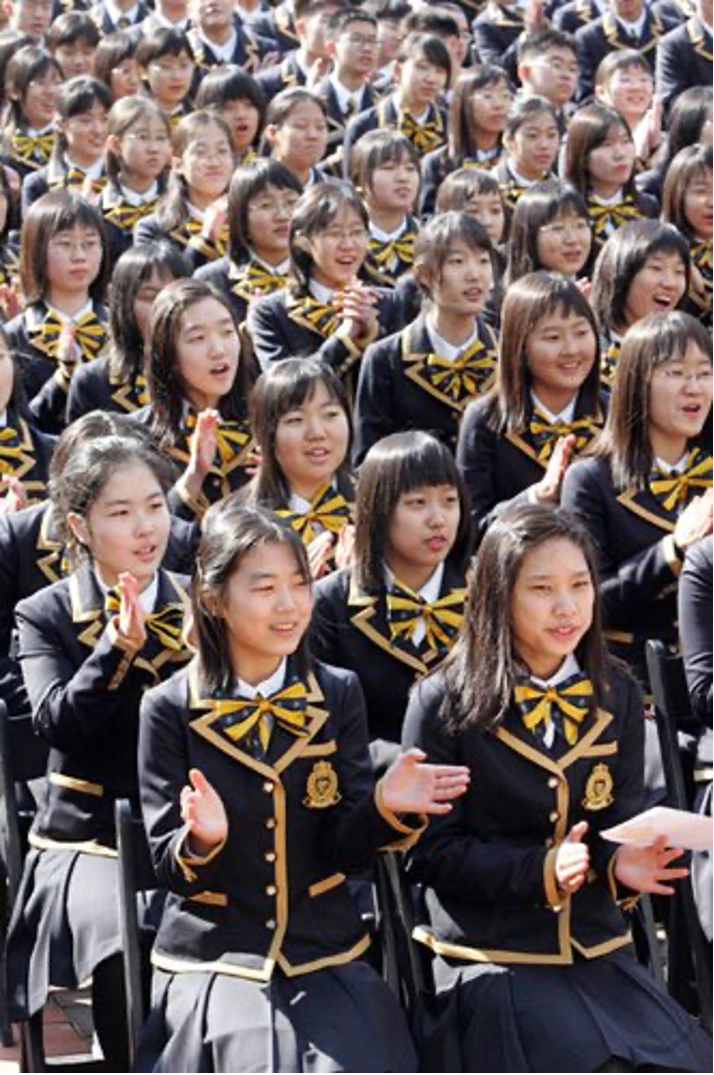
Identity Building and School Uniforms in South Korea: From School to Workplace
Professor Kyunghee Pyun
Fashion Institute of Technology, State University of New York
Fashion Institute of Technology, State University of New York
Tuesday, April 5, 2022
Online Event
5:00 pm – 6:00 pm EDT/GMT-4
This event will be on Zoom.5:00 pm – 6:00 pm EDT/GMT-4
Using sociologist Erving Goffman’s theory of “impression management,” the paper explores how citizens in South Korea have constructed their identity by dressing themselves for school and then later for workplace. A mandatory school uniform policy was applied to all the schools from the early twentieth century to the 1970s. A brief period of deregulated school uniform policy in the mid 1980s was succeeded by consumer-centered fashionable student uniforms (haksaengbok), inundated with fashion photography in teen magazines from the 1990s to the present. Students were not the only group of citizens under the strict dress code. During the throbbing process of modernization, industrialization, and globalization in the twentieth century, many female workers were under industry-specific dress code: banks, large corporations, factories, hospitals, retail stores, restaurants, and cultural organizations. Applying the sociological methodologies of impression management, this paper analyzes process and meaning in mundane interaction of students dressed in school uniforms and workers in workplace uniforms. The paper argues that dress code is punitive as it forces individuals to building one’s identity by subjecting oneself submissive to values and desirable performances dictated by authorities. Despite the homogeneous environment of members in the same style of dresses, individuals develop a subtle discernment of one’s physical shortcomings and sartorial habits. They also recognize other people’s physiognomy and styling characteristics. As a way of differentiating themselves within a group dressed alike, members develop a sense of “microstyling” by adjusting minor elements like sleeves, jacket fastening, or helms. Or they resort to measures of enhancing or altering their body parts.
Kyunghee Pyun is associate professor of art history at the Fashion Institute of Technology, State University of New York. Her scholarship focuses on history of collecting, reception of Asian art, diaspora of Asian artists, and Asian American visual culture. She wrote Fashion, Identity, Power in Modern Asia (Palgrave Macmillan, 2018) discussing modernized dress in the early 20th-century. She also co-edited Interpreting Modernism in Korean Art: Fluidity and Fragmentation (Routledge 2021); American Art from Asia: Artistic Praxis and Theoretical Divergence (Routledge 2022); and Expanding the Parameters of Feminist Artivism (Palgrave Macmillan, 2022). She is writing a new book, School Uniforms in East Asia: Fashioning Statehood and Self (Palgrave Macmillan, 2022; forthcoming) and plans another book entitled Dressed for Workplace.
For more information, call 845-758-6822, e-mail [email protected],
or visit https://bard.zoom.us/j/89376909625?pwd=elBlUThseHJ6ZXJTU3U1bU9qN3dMZz09.
Time: 5:00 pm – 6:00 pm EDT/GMT-4
Location: Online Event
 Save this Event: