Physics Program Presents
Probing the Invisible Universe with Variability
Colin Burke, Yale University
Friday, October 16, 2026
Brody Lab - Hegeman 107
12:00 pm EDT/GMT-4
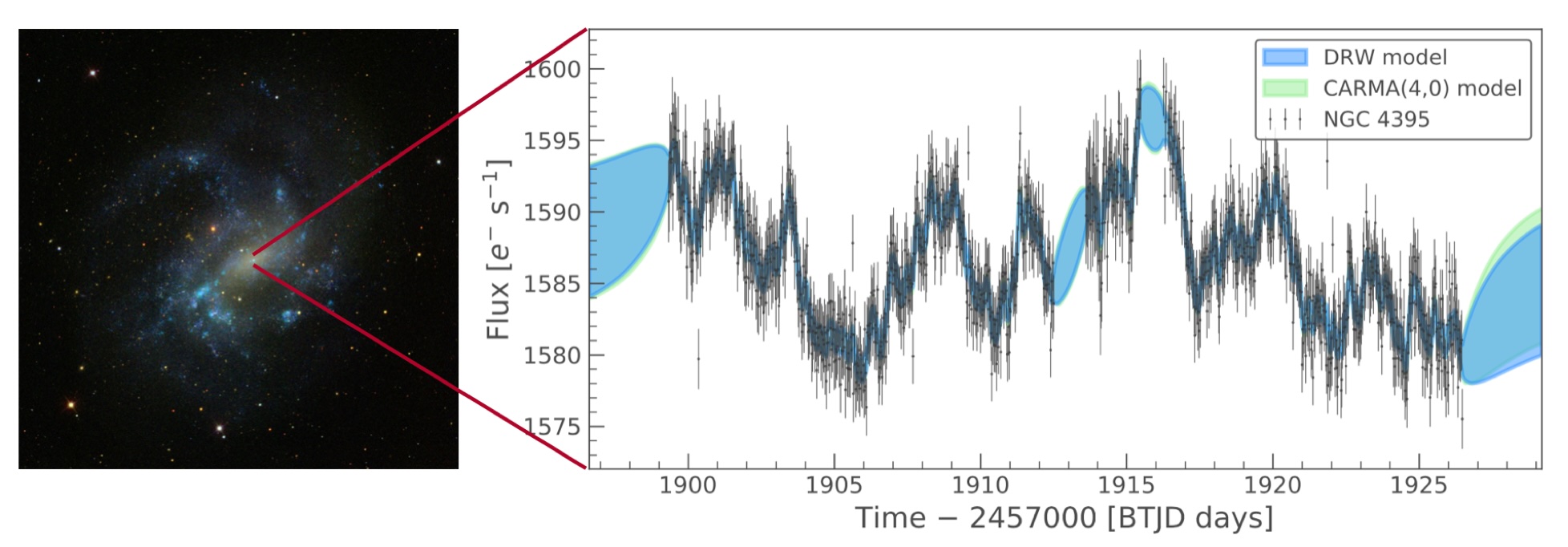
The Vera C. Rubin Observatory will imminently transform time-domain astrophysics by enabling precision, long-baseline optical variability measurements for billions of sources. Time-domain variability provides a uniquely powerful window into the otherwise invisible components of the Universe, from the physics of accreting black holes to the nature of dark energy driving cosmic acceleration. In this talk, I will present several projects that leverage optical variability to address fundamental open questions in astrophysics and cosmology. First, I will show how variability-selected active galactic nuclei (AGN) in low-mass galaxies can be used to identify the elusive intermediate-mass black holes (IMBHs) and discriminate between competing models of supermassive black hole formation and growth. I will then discuss how stochastic variability encodes key aspects of accretion physics, offering new empirical constraints on black hole mass, accretion state, and disk structure. Finally, I will demonstrate how AGN variability can be standardized to construct independent distance indicators, enabling new probes of dark energy and the expansion history of the Universe. 12:00 pm EDT/GMT-4
For more information, call 845-758-6822, or e-mail [email protected].
Time: 12:00 pm EDT/GMT-4
Location: Brody Lab - Hegeman 107
 Save this Event: