Physics Program Presents
The Life and Times of Drosophila melanogaster: Lessons on Individuality and Aging from the Humble Fruit Fly
Grace McKenzie-Smith, Wesleyan University
Friday, September 18, 2026
Brody Lab - Hegeman 107
12:00 pm EDT/GMT-4
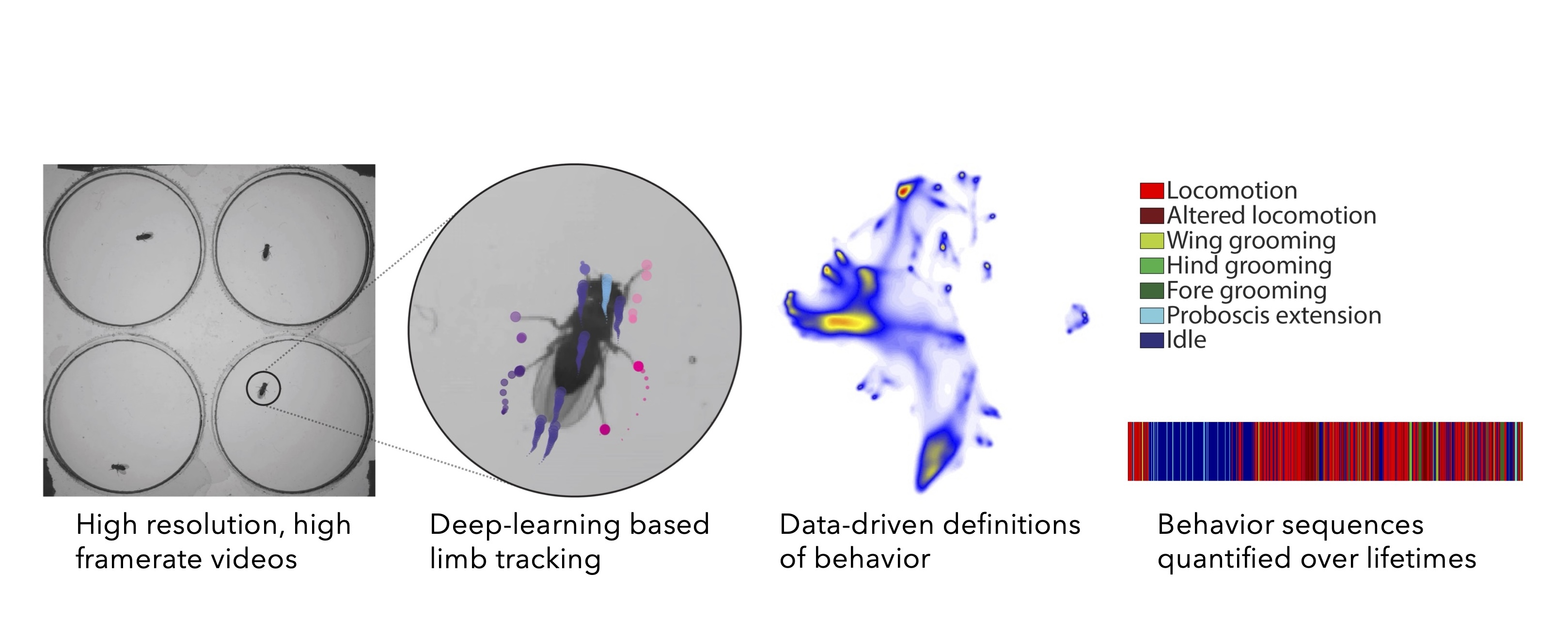
Animal behavior unfolds over many timescales, from sub-second motions to circadian cycles to the lifelong process of aging. We study this multi-timescale structure in order to understand the nature and evolution of individuality. Our work approaches this problem from two angles. From one side, we take extremely high resolution (~30 pixels/mm) recordings at high frame rate (100 frames per second) for the entire lifespan (3-8 weeks) of Drosophila melanogaster fruit flies. Using deep-learning-based postural estimation and unsupervised machine-learning behavioral classifications, we quantify the hourly, daily, and lifelong patterns of Drosophila behavior. We identify the hour after dawn as a behaviorally unique moment in the circadian pattern of Drosophila, and find that certain grooming behaviors are highly correlated with individuality and lifespan. We also study the behavioral effects of two longevity-promoting drugs, rapamycin and metformin, to determine if treated flies demonstrate youthful behaviors throughout their extended lives. From the other side, we examine the fine structure of behavior evolving on seconds- to hours- long timescales. We find that flies (and other organisms) can be distinguished by idiosyncratic leg sweeps during locomotion, but that a fly’s particular leg pattern is not stable throughout its life, demonstrating enough drift over 4-7 days for a fly to be classified as “completely distinguishable” from its former self. Thus we find that individuality may be lifelong or fleeting, depending on the resolution and timescale at which it is measured.12:00 pm EDT/GMT-4
For more information, call 845-758-6822, or e-mail [email protected].
Time: 12:00 pm EDT/GMT-4
Location: Brody Lab - Hegeman 107
 Save this Event: