Upcoming Events
-
4/07TuesdayOnline Event
Levy Graduate Programs in Economic Theory and Policy Applications Are Open!
Deadlines: Early Decision on January 15th & Regular Decision on April 15th
Monday, September 1, 2025 – Wednesday, April 15, 2026Levy's Master of Arts & Master of Science Programs in Economic Theory and Policy provide instruction grounded in the Levy Institute's innovative approaches to the pressing economic issues of our time. Small class sizes, rigorous coursework in diverse economic perspectives, and a focus on original research with the internationally recognized scholars at the Levy Institute set our alumni apart in their careers in public policy, academic research, finance, and the private sector.
Online Event
Contact: Tyler Emerson
Phone: 845-758-7776
E-mail: [email protected]
-
4/08Wednesday12:00 pm – 2:00 pm EDT/GMT-4
Bertelsmann Campus Center, Lobby
NEWSROOM
Pocketbook Issues Such as Raising Minimum Wages, Paid Leave, and Protecting Public Education Could Sway the American Electorate, New Levy Economics Institute Report Says
"Americans are far more progressive than either party gives them credit for. Whatever path forward Democrats choose, winning back the working class would be a long process without a big and bold vision,” says coauthor Pavlina R. Tcherneva.
Pocketbook Issues Such as Raising Minimum Wages, Paid Leave, and Protecting Public Education Could Sway the American Electorate, New Levy Economics Institute Report Says
Long-Term Voting Trends Show Democrats Losing Working Class Support Due to Absence of Clear Vision for Popular Progressive Economic Policies
The Levy Economics Institute of Bard College has published a policy brief outlining economic policies that improve the lives of working-class families and could sway the American electorate. That “Vision Thing”: Formulating a Winning Policy Agenda, Levy Public Policy Brief No. 158, coauthored by Levy Economics Institute President Pavlina R. Tcherneva and Senior Scholar L. Randall Wray, analyzes the shifting allegiances of American voters over the decades as the Democratic Party lost the support of its traditional base—blue-collar and rural counties—and came to be seen as the party of the educated elite, socially liberal, and relatively economically secure.
“Trump was the beneficiary of a long-term retreat of working-class voters from the Democratic Party. But becoming the party of the economically secure in a world of runaway inequality, rising precarity, and widespread frustration with many aspects of the economy does not and will not win elections. Still, as we show in this report, Americans are far more progressive than either party gives them credit for. Whatever path forward Democrats choose, winning back the working class would be a long process without a big and bold vision,” says Tcherneva.
For the first time since 1960, Democrats earned a greater margin of support among the richest third of American voters in 2024 than they did among the poorest or middle third. Meanwhile, Trump gained more vote share in counties rated as distressed—and gained less in prosperous counties—despite those counties benefiting significantly and performing better economically under President Biden’s policies that boosted government assistance. In spite of the Democratic focus on inequality, the party fails to reach the financially disadvantaged (who are the true swing voters) with their message, the report asserts.
“Democrats had neither delivered on nor even highlighted the changes that many voters wanted: policies that would provide economic benefits. They were tired of inflation that reduced purchasing power, wages that remained too low (even in supposedly good labor markets) to support their families, and many other issues related to economic precarity, including the costs of healthcare, prescription drugs, childcare and—for a significant portion—college,” write Tcherneva and Wray.
Assessing ballot measures and polling data, the Levy report identifies worker-friendly policies that would improve the wellbeing of the American working class and win elections. “Americans seem to apply two litmus tests to any proposed policy: (1) how will it impact American jobs and (2) how will it impact American paychecks,” they find. “If tariffs are expected to protect jobs, voters are behind them. If they hurt their paychecks, even conservative-leaning voters are strongly against them.”
Ballot measures indicate voters are more progressive than either party recognizes. Winning policies include: raising minimum wages, lowering taxes on earned income and social security (or eliminating them altogether for tips), making healthcare and education more affordable, protecting funding for public schools, increasing Pell grants, reducing the costs of higher education, and implementing paid sick and family leaves. Importantly, whenever asked, Americans strongly support federal programs of direct employment and on-the-job training—in the form of a federal job guarantee or national service for youths in jobs that support the community and the environment. They also care about rebuilding public infrastructure and investing in arts and culture.
Moreover, voters want policies that protect them from price increases, corporate greed, predatory interest rates, and hidden fees. They support more progressivity in the tax system and fewer tax loopholes for billionaires. They are tired of the dominance of billionaires in lobbying by special interests and campaign finance.
“Employment security, economic mobility, community rehabilitation, and environmental sustainability are winning messages. But they are especially powerful when anchored in concrete policies that directly deliver what they promise—good jobs, good pay, decent benefits, affordable health, education, food, and a peace of mind that Americans can care for loved ones without the threat of unemployment or price shocks or the loss of essential benefits,” the report concludes.
Post Date: 03-10-2025
Bard Economist Pavlina Tcherneva’s Work on the Job Guarantee Becomes Focus of US National High School Debate Topic
Thousands of high school students across the United States have been studying Bard Professor of Economics and Research Scholar of the Levy Economics Institute Pavlina Tcherneva’s work on the job guarantee in preparation for their 2023–24 national debate tournaments, which take on the topic of economic inequality. “Personally, I can’t think of a greater impact of my work than seeing young people engage with it, study it, and defend its principles,” says Tcherneva.
Bard Economist Pavlina Tcherneva’s Work on the Job Guarantee Becomes Focus of US National High School Debate Topic
According to Chris Gentry, program manager of the Policy Debate League for Chicago Public Schools, “Almost every affirmative team across the country is running a jobs guarantee case, and to do so they are pulling heavily on Tcherneva’s publications.” During one weekend tournament, Gentry realized that essentially every debate relied on Tcherneva’s work. In just one round that he was judging, 10 different articles or books that she wrote had been quoted. “At least twice this last weekend, I heard ‘well that’s not what Tcherneva is trying to get at here,’” he added. Another high school debate coach in Los Angeles confirmed that Tcherneva has likely been the most cited author in high school debate this year, and as a result the student debaters are quite familiar with her work.
“Personally, I can’t think of a greater impact of my work than seeing young people engage with it, study it, and defend its principles,” says Tcherneva. After meeting with a group of high school student debaters this month, she adds, "The questions the students asked about the job guarantee were probing, well-informed, thoughtful, and inspired—with a keen focus on social justice. I hope that some of them will become policy makers.”
Inspired by this nationwide student engagement, Tcherneva has also opened up spots in her summer workshop “Public Finance and Economic Policy” to select high-school debate students interested in going deeper into Modern Monetary Theory and the job guarantee. Organized and hosted by Bard College and the OSUN Economic Democracy Initiative (EDI), this five-day workshop taking place online June 17–21 is for undergraduate students interested in public policy to tackle economic instability and insecurity, and in understanding the financing capacity and policy space available to governments to pursue these aims. Applications from high school debate students will be reviewed in April and early May. Students can apply here.
Tcherneva also recently developed a resource tool jobguarantee.org, created and maintained by Bard College students and alumni, with the support of OSUN, for anyone interested in learning more about the job guarantee policy innovation.
Centered on the well-being of some of the most vulnerable parts of the US population, the 2023–24 national debate topic of “Economic Inequality” prevailed over “Climate Change” and represents a pressing issue at the forefront of our collective societal consciousness.
Post Date: 04-03-2024
Professor Pavlina Tcherneva on the Disconnect Between Biden’s Great Economic Numbers and How Voters Feel about the Economy
Professor of Economics Pavlina Tcherneva discusses the disconnect between the way economists see the US economy and the way families experience it. “Housing affordability, health care, education—these things have not fundamentally changed,” she tells Ian Masters on Background Briefing. “We emerged out of this COVID pandemic without some profound structural changes. [...] There were some policies that seemed to work and they expired, and others that we don’t see the benefits from yet. But I think that basically that is the message: we are back to the status quo.”
Professor Pavlina Tcherneva on the Disconnect Between Biden’s Great Economic Numbers and How Voters Feel about the Economy
Post Date: 02-06-2024
More News
-
Bard Economist Pavlina Tcherneva Provides Expert Opinion on UN Job Guarantee Report, to Speak at Report’s Official Launch on June 30
Bard Economist Pavlina Tcherneva Provides Expert Opinion on UN Job Guarantee Report, to Speak at Report’s Official Launch on June 30
Pavlina Tcherneva, associate professor of economics at Bard College, provided expert opinion during the preparation of the new United Nations report on the job guarantee, “The Employment Guarantee as a Tool in the Fight Against Poverty.” Professor Tcherneva collaborated with UN Special Rapporteur on Extreme Poverty and Human Rights Olivier De Schutter on the project.Pavlina Tcherneva, associate professor of economics at Bard College.
“The UN report is a significant recognition of the job guarantee as a key strategy for addressing unemployment, poverty, and inequality,” says Professor Tcherneva. “Nation states concerned with these issues will have the opportunity to respond and, if so willing, adopt the technical recommendations outlined in the report.”
Tcherneva will participate in the official launch of the report on June 30, in a side event held on the occasion of the 53rd session of the UN Human Rights Council in Geneva. The event is jointly organized by the UN special rapporteur on extreme poverty and human rights and ATD Fourth World, and cosponsored by the Permanent Mission of Belgium and the Permanent Mission of Luxembourg to the United Nations in Geneva.
Tcherneva will speak remotely on a panel moderated by Olivier De Schutter, and will be joined by Aye Aye Win, president of the International Committee for October 17th; Kate Philip, programme lead on the Presidential Employment Stimulus, South Africa; and Mito Tsukamoto, chief of the Development and Investment Branch (DEVINVEST) of the Employment Policy Department at the International Labour Office (ILO).
For more information about the event, including the concept note and list of speakers, visit srpoverty.org.
Pavlina Tcherneva is an associate professor of economics at Bard College, the director of the OSUN Economic Democracy Initiative, and a research scholar at the Levy Economics Institute at Bard College. She is the author of The Case for a Job Guarantee (Polity, 2020) which has been published in eight languages.
Post Date: 06-20-2023
-
Bard Economist Pavlina Tcherneva Interviewed on Background Briefing with Ian Masters
Bard Economist Pavlina Tcherneva Interviewed on Background Briefing with Ian Masters
Ian Masters spoke with Pavlina Tcherneva, associate professor of economics at Bard College, research associate at the Levy Economics Institute, and author of The Case for a Job Guarantee (2020), on his nationally syndicated radio program Background Briefing. In the episode, “As Pundits Warn of Recession and Inflation, We Get the Best Economic News Since 1969,” Masters asks Tcherneva for her take on the latest U.S. Bureau of Labor Statistics jobs report, which added 517,000 jobs in January 2023 and stunned most economists and people who continue to harbor a doomsday mentality about the economy.Pavlina Tcherneva.
According to Tcherneva, two years after the COVID-induced crisis, such good news about low unemployment levels tells us that “public policy has tools. It can act boldly, quickly and bring jobs back.” She points out, however, that these low unemployment numbers also reflect the 5.7 million people who are not looking for work, and 4 million people who are working part-time but would like to have full-time jobs.
“Part of the anxiety still being experienced in the labor market is that the jobs are there but they are not exactly these well-paying jobs with very good benefits and good working conditions. On that front, there is more to be accomplished. Let us remember our minimum wage is still $7.25, and no one can live on $7.25 an hour,” she asserts.
Tcherneva sees the big fiscal policies implemented over the last two years by the Biden administration, which do not overly focus on the financial sector or prioritize tax cuts for the wealthy, as all good news. Still, she advocates for more economic progress. “The question for me is did we come out of the pandemic with better jobs, better conditions for working families than we had going into the pandemic?”
Post Date: 02-14-2023
-
Professor Pavlina Tcherneva Helps Chart a Path for Job Guarantee Program in Colombia
Professor Pavlina Tcherneva Helps Chart a Path for Job Guarantee Program in Colombia
Pavlina Tcherneva, associate professor of economics at Bard College, research associate at Bard’s Levy Economics Institute, and director of the Open Society University Network's Economic Democracy Initiative, recently met with government officials in Bogotá, Colombia, to present her proposal for a national job guarantee program. At the invitation of Vice Minister of Finance Diego Guevara, Professor Tcherneva met with five government divisions: the ministries of energy, development, finance, and culture, and the SAE (Sociedad de Activos Especiales, or Special Assets Society), which administers seized assets of narcotics traffickers in the country.Bard College Professor Pavlina Tcherneva (center) meets with Colombian Vice Minister of Finance Diego Guevara (L) and Minister of Culture Patricia Ariza (R). Photo courtesy Ministerio de Cultura, Colombia.
“The job guarantee is an economic policy that provides public employment opportunities on demand to anyone seeking decent, living-wage work,” Tcherneva says. “It is a structural stabilization policy that alleviates the economic, social, and political costs of unemployment and precarious employment. It is equity-driven and draws on a long tradition of human rights and social justice.” Governments all over the world have implemented policies that provide some level of job guarantee, though none have a truly universal job guarantee program. One example in U.S. history is the Works Progress Administration. Part of President Franklin Roosevelt’s New Deal, the agency employed millions of Americans on a wide range of public works projects during the Great Depression.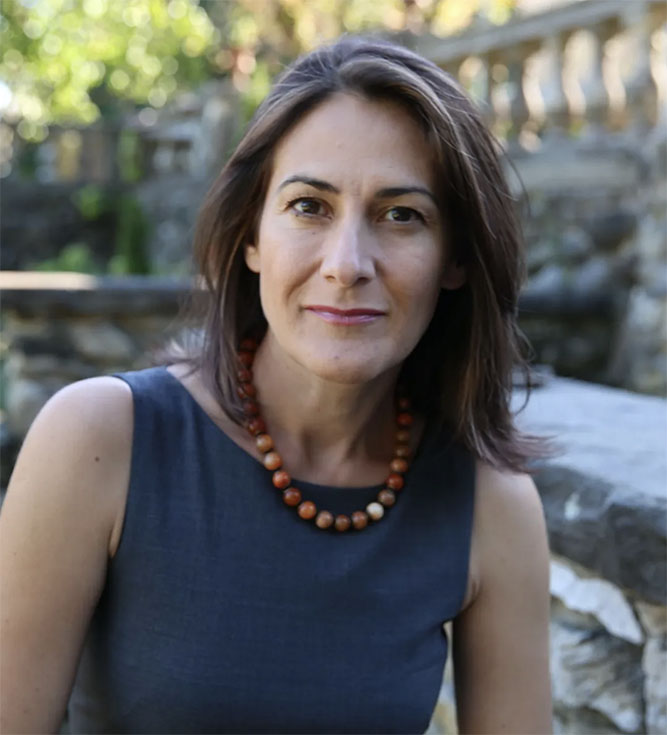 Bard College Professor Pavlina Tcherneva
During Tcherneva’s meetings in Bogotá, Colombian officials proposed to draft pilot public employment projects to further the work of each ministry. SAE, for example, discussed various ways in which the assets of the agency could support the creation of local employment and strengthen the work of grassroots and community organizations. These pilots would also support the public employment component of the national development plan, which President Gustavo Petro will present before the Colombian Congress in May.
“I was inspired by SAE's employment-centered, social inclusion approach to the management of seized assets,” Tcherneva notes. “In much of my policy work, I am asked to explain the innovative aspects of the job guarantee proposal. In Colombia, I had to do very little of that. Instead, I met with policy makers who were not only receptive but were already thinking about how to make it happen.”
During her stay in Colombia, Professor Tcherneva also delivered one of the two opening keynotes at the Third Annual Conference on Heterodox Economics at the National University of Colombia. Her talk was titled “The Role of Women in Heterodox Economics.”
Pavlina Tcherneva is a macroeconomist specializing in modern money theory and public policy, with a focus on fiscal and monetary policy coordination, full employment policies, and their impact on macroeconomic stability, unemployment, income distribution, and gender. Her book The Case for a Job Guarantee (Polity, 2020) was named one of the Financial Times best economics books of 2020 and has been published in eight languages. Her first book, Full Employment and Price Stability: The Macroeconomic Vision of William S. Vickrey (coedited with M. Forstater), is a rare collection of the lesser-known works by Nobel Prize–winning economist William Vickrey and reinterprets his proposals for the modern day. Tcherneva holds a BA in mathematics and economics (Phi Beta Kappa) from Gettysburg College and an MA and PhD in economics from the University of Missouri–Kansas City. She is an expert at the Institute for New Economic Thinking and, formerly, a visiting research fellow at the University of Cambridge Centre for Economic and Public Policy in the United Kingdom. Bard College Professor Pavlina Tcherneva meets with and SAE Director Daniel Rojas Medellin. Photo courtesy Sociedad de Activos Especiales, Colombia.
Post Date: 12-13-2022
-
Levy Graduate Student Simon Grothe MS ’22 Wins Association for Institutional Thought Student Scholars Award Competition
Levy Graduate Student Simon Grothe MS ’22 Wins Association for Institutional Thought Student Scholars Award Competition
Simon Grothe, who is completing his master of science in economic theory and policy at the Levy Economics Institute of Bard College, has been selected as one of three winners of the 17th Annual AFIT-AFEE Student Paper Competition. Grothe won for his paper “Financial Instability Hypothesis and Consumer Finance. A Marxian Perspective on Old Age Capitalism.” Grothe will be presenting his paper at the annual Association for Institutional Thought (AFIT) conference on April 1 in Denver. “I'm very thankful for all the Levy scholars and for their strength in carrying progressive ideas through reactionary times. It’s vital we talk more about capitalism and how we can dismantle a system that serves the few and not the many,” says Grothe.Simon Grothe MS ’22.
The AFIT-AFEE Student Paper Competition seeks to encourage undergraduate and graduate students to pursue research topics in the field of Evolutionary-Institutional Economics, and related heterodox schools of thought such as Social and Solidarity Economics, Post-Colonial Studies, and other pluralist methodologies.
Post Date: 03-29-2022
-
Professor Pavlina R. Tcherneva: A Just Transition Needs a Job Guarantee
Professor Pavlina R. Tcherneva: A Just Transition Needs a Job Guarantee
Associate Professor of Economics Pavlina R. Tcherneva says a job guarantee is necessary both for managing the disruptions wrought by global warming and for achieving a smooth, just transition to a low-carbon economy. And since the policy is also wildly popular, it should be a no-brainer for any politician who claims to be serious about tackling the climate crisis. “If ‘decent work for all’ is to become an actionable policy benchmark, access to a living-wage job must be guaranteed to everyone, not merely implied in the text of stimulus packages and other policies,” she writes.
Post Date: 09-21-2021
-
Alex T. Williams MS ’20 on the Global Tug of War Over Semiconductors
Alex T. Williams MS ’20 on the Global Tug of War Over Semiconductors
Your car, toaster, even washing machine can’t work without them. And there’s a global shortage. So writes Alex T. Williams MS ’20—an alum of the Levy Institute MS in Economic Theory and Policy Program—who traces the precarity of supply chains that deliver the microchips at the heart of countless products in our modern economy.
Post Date: 05-18-2021
-
Federal Reserve Bank of Chicago President Charles Evans Plays Down the Risk of Higher Inflation at the Levy Institute’s 29th Annual Hyman P. Minsky Conference
Federal Reserve Bank of Chicago President Charles Evans Plays Down the Risk of Higher Inflation at the Levy Institute’s 29th Annual Hyman P. Minsky Conference
“‘I think the risk of this scenario is remote,’ Evans said Wednesday during a virtual conference hosted by the Levy Economics Institute of Bard College,” reports Bloomberg. “The Chicago Fed chief, who has long been one of the central bank’s biggest worriers about inflation being too low, was responding to critics of the Biden administration’s fiscal programs, which include not only Republicans but also some economists associated with the Democratic party.”Chicago Federal Reserve President Charles Evans. Photo by Alejandro Cegarra/Bloomberg
Post Date: 05-05-2021
-
Levy Economics Institute Senior Scholar Rania Antonopoulos to Speak March 31 at European Trade Union Institute (ETUI) Webinar on Job Guarantee Programs in Europe
Levy Economics Institute Senior Scholar Rania Antonopoulos to Speak March 31 at European Trade Union Institute (ETUI) Webinar on Job Guarantee Programs in Europe
Antonopoulos, director of the Gender Equality and the Economy program at the Levy Institute, and other speakers will explore what role job guarantee programs could play as Europe emerges from the historic economic turbulence of the pandemic. “The pandemic has brought into even sharper relief issues of labour market and social inequality which will have to be addressed if a new and sustainable socio-economic contract is to be agreed and lead the necessary economic and societal transformations,” writes ETUI.Levy Economics Institute Senior Scholar Rania Antonopoulos. Courtesy Twitter.
Post Date: 03-30-2021
-
New Study Coauthored by Bard Alumnus Marokey Sawo MS ’20 Challenges Claim that Unemployment Recipients Are “Overpaid”
New Study Coauthored by Bard Alumnus Marokey Sawo MS ’20 Challenges Claim that Unemployment Recipients Are “Overpaid”
Marokey Sawo, a 2020 graduate of the Levy Economics Institute master’s program in economic theory and policy, and coauthor Michele Evermore take a second look at the percentage of laid-off workers getting better pay from the enhanced unemployment benefits that expired last week. “Many workers lose more than just wages in unemployment―they lose employer contributions to health insurance, paid leave, and retirement benefits as well,” they write. “These individuals are likely receiving less, not more, in unemployment than they were in their former jobs, even after accounting for the $600 per week benefits boost.”Applicants for unemployment benefits in New York
Post Date: 08-06-2020
JOIN THE CONVERSATION